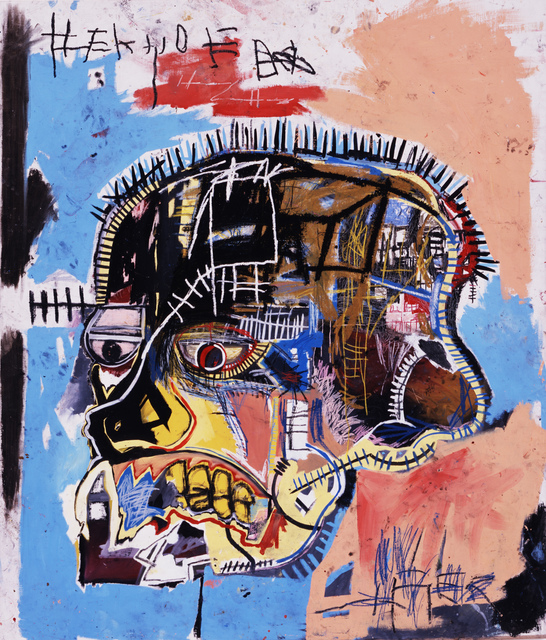
Jean-Michel Basquiat (French: [?? mi??l baskija]; December 22, 1960 – August 12, 1988) was an important American artist of Haitian and Puerto Rican descent. Basquiat first achieved fame as part of SAMO, an informal graffiti duo who wrote enigmatic epigrams in the cultural hotbed of the Lower East Side of Manhattan during the late 1970s, where hip hop, punk, and street art cultures coalesced. By the 1980s, his neo-expressionist paintings were being exhibited in galleries and museums internationally. The Whitney Museum of American Art held a retrospective of his art in 1992.
Basquiat's art focused on "suggestive dichotomies", such as wealth versus poverty, integration versus segregation, and inner versus outer experience. He appropriated poetry, drawing, and painting, and married text and image, abstraction, figuration, and historical information mixed with contemporary critique.
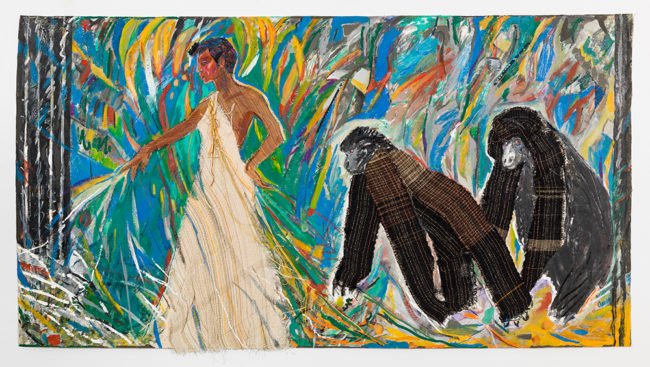
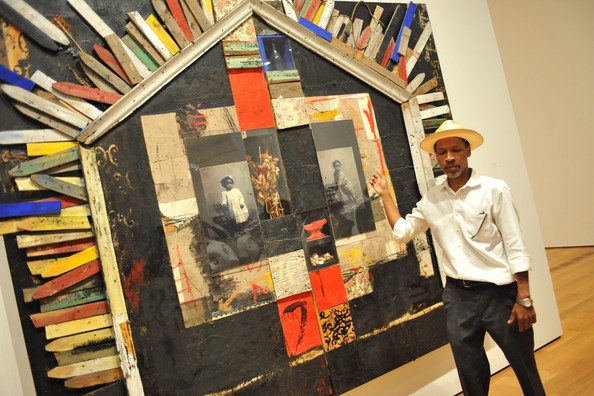
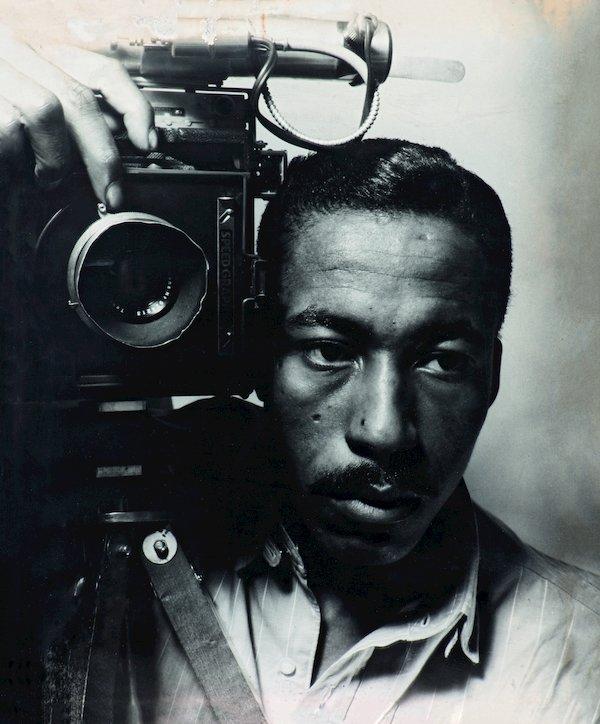
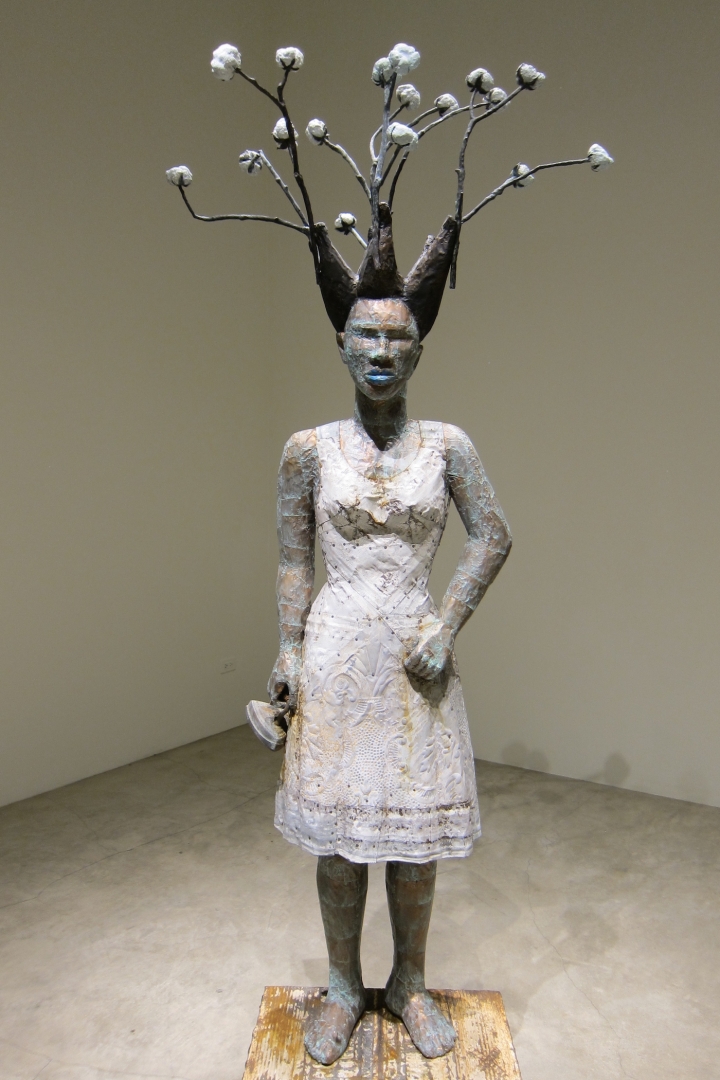
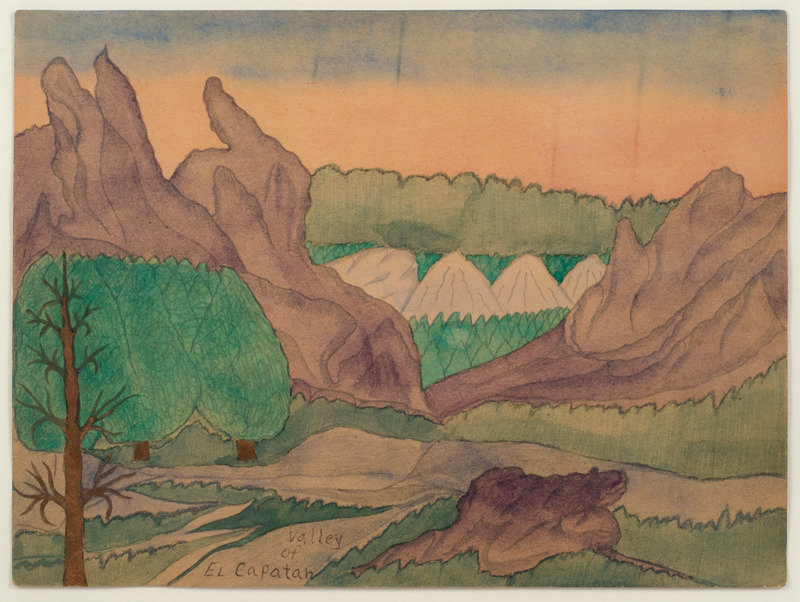
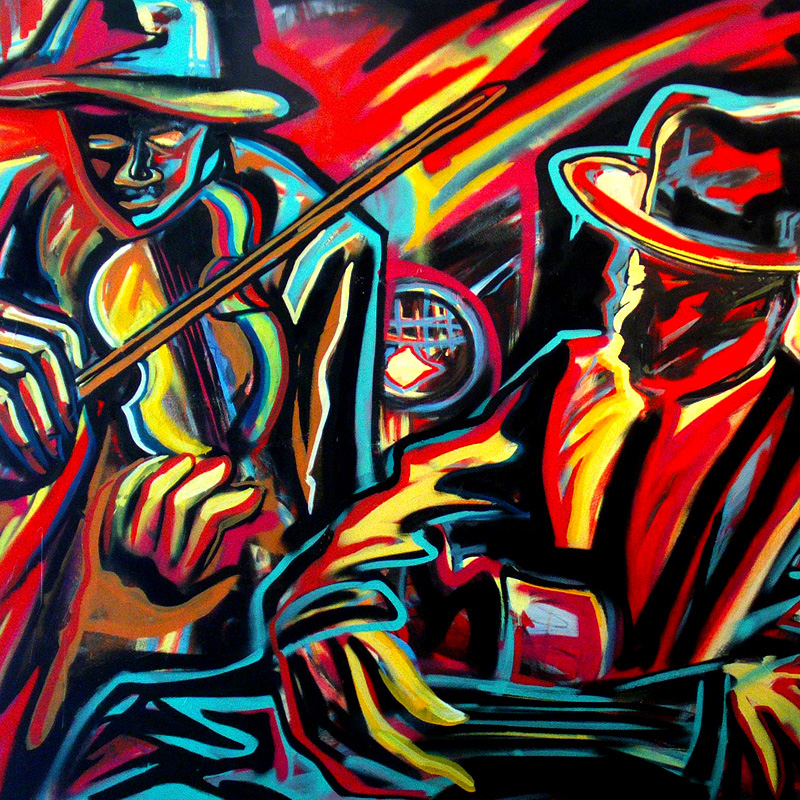
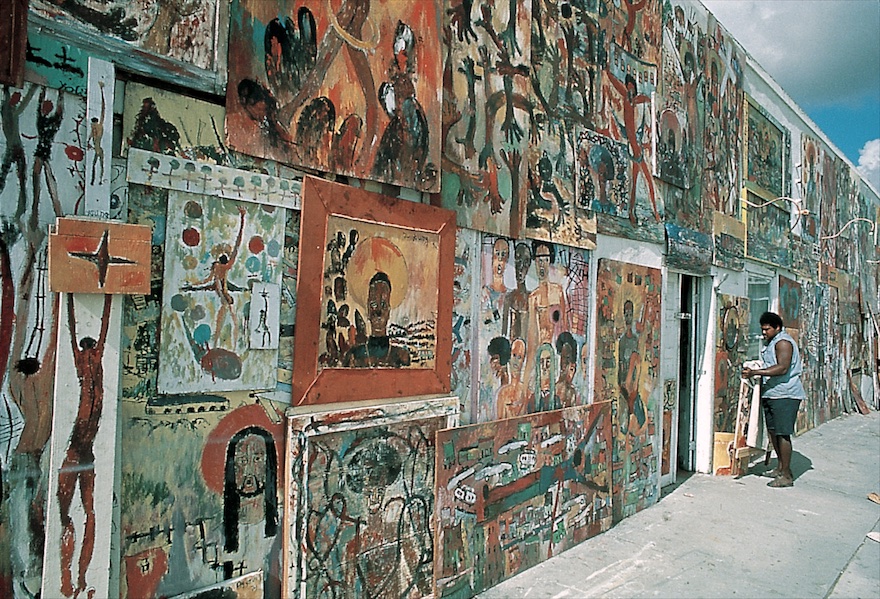
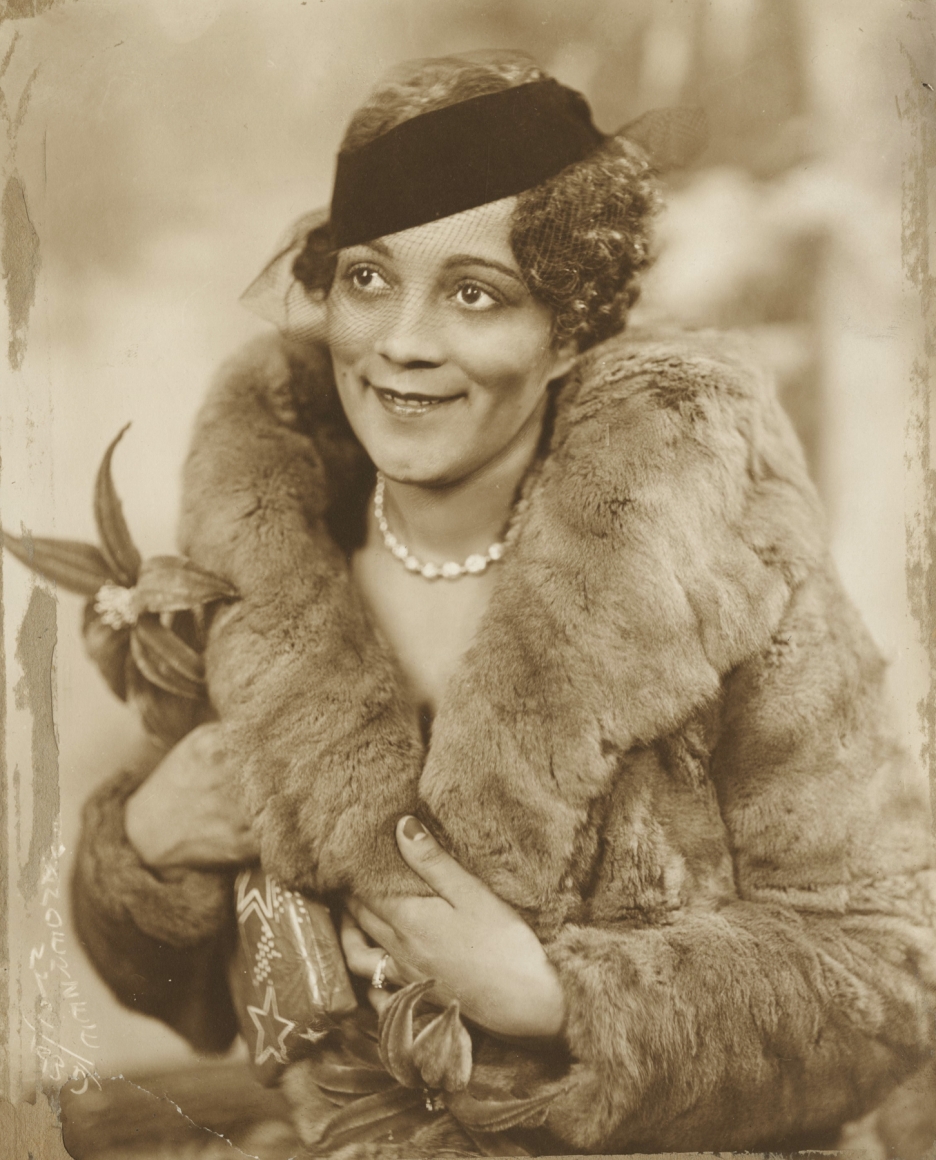
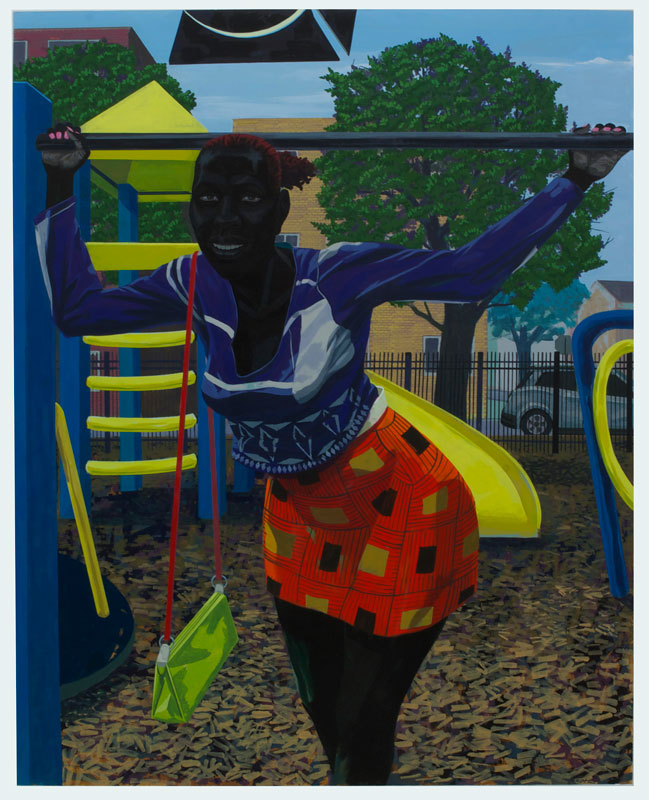
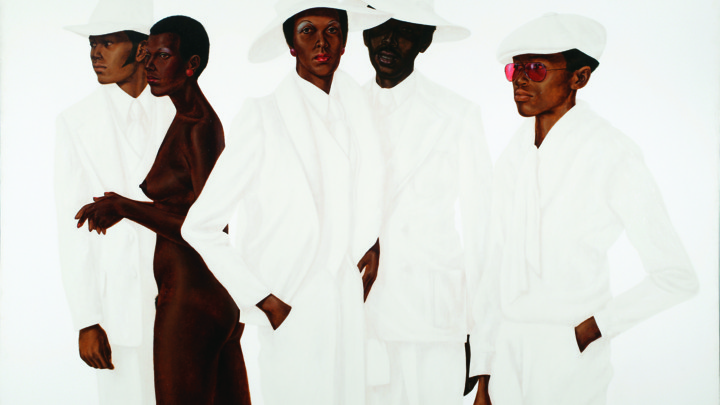
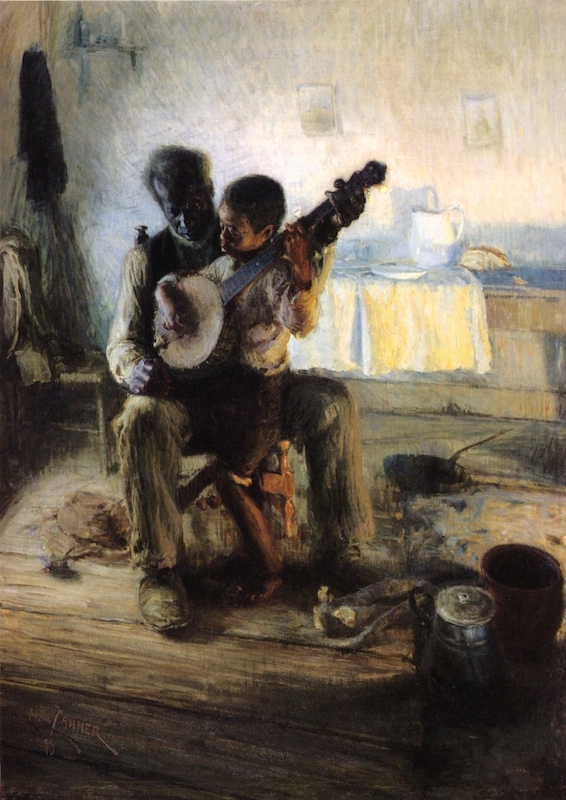
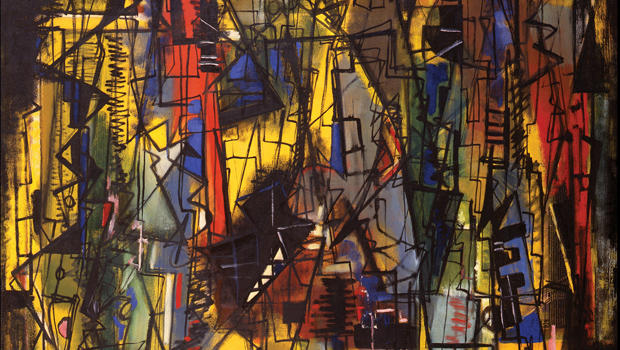
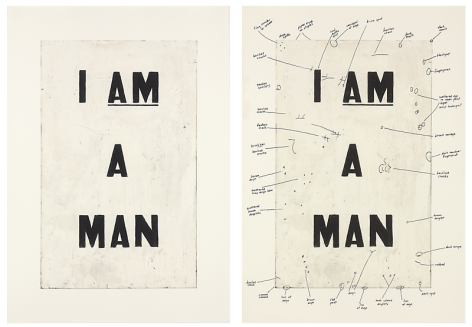
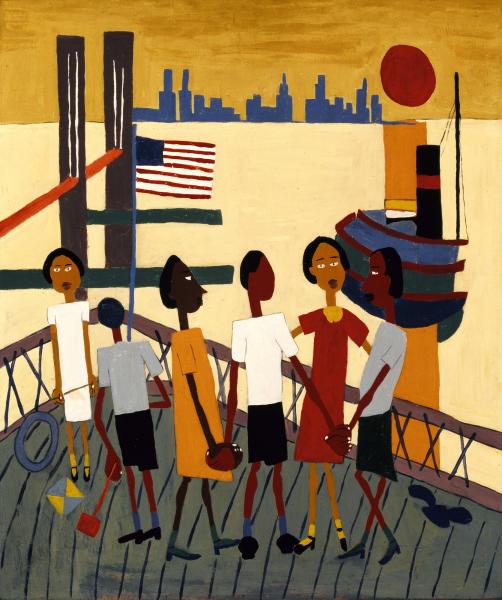
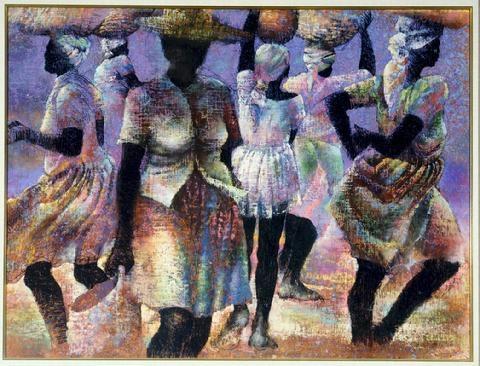
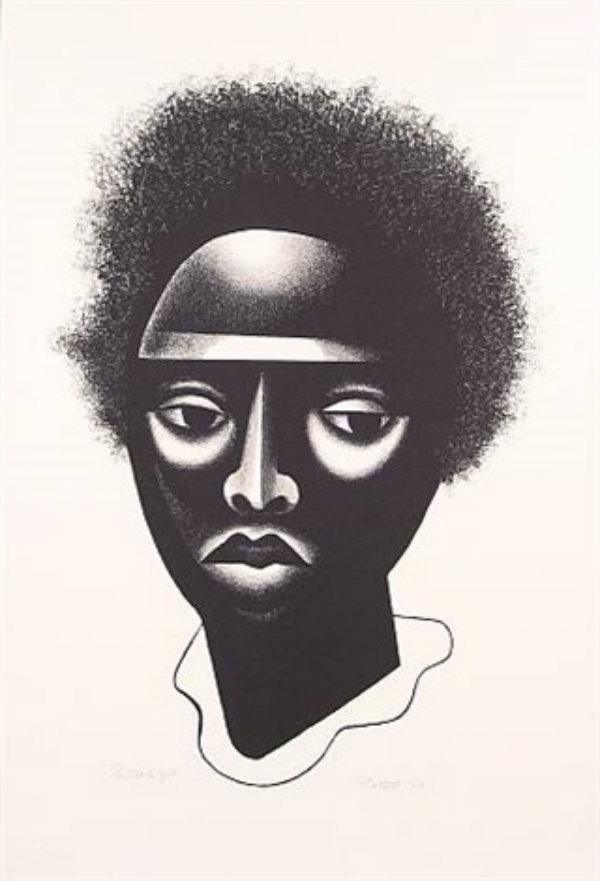
Emma Amos Emma Amos was born in Atlanta, Georgia on March 16, 1938 to India DeLaine Amos and Miles Green Amos. Amos took an interest in art at an early age, creating "masses of paper dolls" and learning figure drawing from issues of Esquire and the art of Alberto Vargas, was painting the figure by the age of nine. Her mother had aspirations of Amos studying with Hale Woodruff, but he did not accept many private students and left the area before she had the opportunity to study with him. At eleven, Amos took a course at Morris Brown College, where she worked on her draftsmanship and took note of the work that African American college students were producing at the time. By high school, Amos was submitting her work to Atlanta University art shows. She graduated from Booker T. Washington High School in Atlanta at the age of 16, and applied to Antioch College, because of their progressive policies. Her father exposed her to black intelligentsia; Zora Neale Hurston frequently visited and W.E.B. Du Bois once called on the family. Romare Bearden Romare Bearden (September 2, 1911 – March 12, 1988) was an African-American artist and author of a history of his people's art. He worked with many types of media including cartoons, oils and collages. Born in Charlotte, North Carolina, Bearden grew up in New York City and Pittsburgh, Pennsylvania, and graduated from NYU in 1935. He began his artistic career creating scenes of the American South. Later, he worked to express the humanity he felt was lacking in the world after his experience in the US Army during World War II on the European front. He returned to Paris in 1950 and studied Art History and Philosophy at the Sorbonne. Bearden's early work focused on unity and cooperation within the African-American community. After a period during the 1950s when he painted more abstractly, this theme reemerged in his collage works of the 1960s. New York Times described Bearden as "the nation's foremost collagist" in his 1988 obituary. Bearden became a founding member of the Harlem-based art group known as The Spiral, formed to discuss the responsibility of the African-American artist in the civil rights movement. Radcliffe Bailey Radcliffe Bailey was born in Bridgeton, New Jersey in 1968. At age 4, he moved to Atlanta, Georgia, which is where he currently resides. His interest in art was galvanised by childhood visits to the High Museum of Art and drawing classes he later took at the Atlanta College of Art. He cites the Atlanta's history with civil rights and the Civil War as an artistic inspiration. Bailey received a Bachelor of Fine Arts in 1991 from the Bachelor of Fine Arts from the Atlanta College of Art. From 2001 to 2006, he taught in the Lamar Dodd School of Art at the University of Georgia. Bailey was trained as a sculptor but experiments with paint and mixed media. He works within the convergence of painting and sculpture, utilising items, such as vintage photographs of his family, vinyl records, piano keys and bottle-caps. Thematically, his art explores the intersection of ancestry, race and cultural memory. In 2003, he adopted a style of art conceptually inspired by Kongo minkisi, which he described as being "medicine cabinet sculptures". As a result, his work has been described as being three-dimensional and layered, incorporating elements of smell and sound Gordon Parks Gordon Roger Alexander Buchanan Parks (November 30, 1912 – March 7, 2006) was an American photographer, musician, writer and film director, who became prominent in U.S. documentary photojournalism in the 1940s through 1970s—particularly in issues of civil rights, poverty and African-Americans—and in glamour photography. As the first famous pioneer among black filmmakers, he was the first African American to produce and direct major motion pictures—developing films relating the experience of slaves and struggling black Americans, and creating the "blaxploitation" genre. He is best remembered for his iconic photos of poor Americans during the 1940s (taken for a federal government project), for his photographic essays for Life magazine, and as the director of the 1971 film Shaft. Parks also was an author, poet and composer. Alison Saar Alison Saar (born February 5, 1956) is a Los Angeles, California based sculptor, mixed-media, and installation artist. Her artwork focuses on the African diaspora and black female identity and is influenced by African, Caribbean, and Latin American folk art and spirituality. Saar is well known for "transforming found objects to reflect themes of cultural and social identity, history, and religion." Saar was born in Los Angeles, California, to a well-known African-American sculptor and installation artist, Betye Saar, and Richard Saar, an art conservationist. Saar's mother Betye was involved in the 1970s Black Arts Movement and frequently took Alison and her sisters, Lezley and Tracye, to museums and art openings during their childhood. They also saw Outsider Art, such as Simon Rodia's Watts Towers in Los Angeles and Grandma Prisbrey's Bottle Village in Simi Valley. Saar's love of nature, intense interest in vernacular folk art and admiration of artists' ability to create beauty through the use of discarded items stemmed from her upbringing and exposure to these experiences and types of art. Joseph Yoakum Joseph Elmer Yoakum (February 22, ca. 1890 – December 25, 1972) was a self-taught landscape artist of African-American and possible Native American descent, who drew landscapes in a highly individual style. He was 76 when he started to record his memories in the form of imaginary landscapes, and he produced over 2,000 drawings during the last decade of his life. His work is an example of Outsider Art. Corey Barksdale Atlanta artist Corey Barksdale was born in Nashville, Tennessee into a family of Artists. He was exposed to color and form at an early age by his grandmother a quilt artist, and his mother who was gifted with an intuitive feeling for design and a fastidiousness for detail which she expressed in all aspects of her daily life. This rich beginning is the root of Barksdale's creative expression. Barksdale earned his Bachelor of Fine Arts Degree at the prestigious Atlanta College of Art in 1994. During this period he was heavily influenced by the abstract expressionists and admired such mainstream artists as Jasper Johns, Clifford Still, William deKooning. The African-American masters Aaron Douglas, John Biggers, Romere Bearden, and William Tolliver instilled in him a appreciation of African/American artistic heritage. Purvis Young Purvis Young (February 4, 1943 – April 20, 2010) was an American artist from the Overtown neighborhood of Miami, Florida. Young's work, often a blend of collage and painting, utilizes found objects and the experience of African Americans in the south. A self-taught artist, Young gained recognition as a cult contemporary self-taught artist, with a collectors' following including the likes of Jane Fonda, Damon Wayans, Jim Belushi, Dan Aykroyd, among others. In 2006 a feature documentary entitled Purvis of Overtown was produced about his life and work. His work is found in the collections of the American Folk Art Museum, the Corcoran Gallery of Art, the High Museum of Art, the National Museum of African American History and Culture, the Philadelphia Museum of Art, among others. Visit Purvis Young Museum, in Fort Lauderdale, Florida. In 2018, he was inducted into the Florida Artists Hall of Fame. James Van Der Zee James Van Der Zee (June 29, 1886 – May 15, 1983) was an African-American photographer best known for his portraits of black New Yorkers. He was a leading figure in the Harlem Renaissance. Aside from the artistic merits of his work, Van Der Zee produced the most comprehensive documentation of the period. Among his most famous subjects during this time were Marcus Garvey, Bill "Bojangles" Robinson and Countee Cullen. Van Der Zee made his first photographs as a boy in Lenox, Massachusetts. He bought his first camera when he was a teenager, and improvised a darkroom in his parents' home. In 1905, he moved with his father and brother to Harlem in New York City, where he worked as a waiter and elevator operator. In 1915, he moved to Newark, New Jersey, where he took a job in a portrait studio, first as a darkroom assistant and then as a portraitist. He returned to Harlem the following year, setting up a studio at the Toussaint Conservatory of Art and Music that his sister, Jennie Louise Van de Zee, also known as Madame E Toussaint had founded in 1911. Kerry James Marshall Kerry James Marshall (born October 17, 1955) is an American artist born in Birmingham, Alabama. He grew up in South Central Los Angeles and now lives in Chicago, Illinois, where he previously taught at the School of Art and Design at the University of Illinois at Chicago. He is a 1978 graduate of Otis College of Art and Design. An exhibition of his work, Kerry James Marshall: Mastry, was assembled by the Museum of Contemporary Art in 2016. Although he currently lives and works in Chicago, Illinois, his time spent in the Watts neighborhood of Los Angeles, California where the Black Power and Civil Rights movements had a significant impact on his paintings. Strongly influenced by his experiences as a young man, he developed a signature style during his early years as an artist that involved the use of extremely dark, essentially black figures. These images represent his perspective of African Americans, specifically black men with separate and distinct inner and outer appearances. At the same time, they confront racial stereotypes within contemporary American society. This common theme appeared continuously in his work throughout the subsequent decades, especially in the 1980s and 1990s and still appears in his most recent works. Barkley L. Hendricks Barkley L. Hendricks (April 16, 1945 – April 18, 2017) was a contemporary American painter who made pioneering contributions to black portraiture and conceptualism. While he worked in a variety of media and genres throughout his career (from photography to landscape painting), Hendricks' best known work took the form of life-sized painted oil portraits of Black Americans. Born on April 16, 1945, in the North Philadelphia neighborhood of Tioga. Barkley Leonnard Hendricks was the eldest surviving child of Ruby Powell Hendricks and Barkley Herbert Hendricks. His parents had moved to Philadelphia from Halifax County, Virginia during the Great Migration when large numbers of African Americans moved out of the rural Southern United States. Hendricks attended Simon Gratz High School and graduated in 1963. He attended Pennsylvania Academy of the Fine Arts (PAFA). After graduating PAFA in 1967, Hendricks decided to enlist in the New Jersey National Guard and found work as an arts and crafts teacher with the Philadelphia Department of Recreation. In 1970, he began attending Yale University and graduated in 1972 with both a bachelor's and master's degree. Henry Ossawa Tanner Henry Ossawa Tanner (June 21, 1859 – May 25, 1937) was an American artist and the first African-American painter to gain international acclaim. Tanner moved to Paris, France, in 1891 to study, and continued to live there after being accepted in French artistic circles. His painting entitled Daniel in the Lions' Den was accepted into the 1896 Salon, the official art exhibition of the Académie des Beaux-Arts in Paris. After his own self-study in art as a young man, Tanner enrolled in 1879 at the Pennsylvania Academy of the Fine Arts in Philadelphia. The only black student, he became a favorite of the painter Thomas Eakins, who had recently begun teaching there. Tanner made other connections among artists, including Robert Henri. In the late 1890s he was sponsored for a trip to Palestine by Rodman Wanamaker, who was impressed by his paintings of biblical themes. Norman Lewis Norman Wilfred Lewis (July 23, 1909 – August 27, 1979) was an American painter, scholar, and teacher. Lewis, who was African-American (of Bermudian descent), was associated with abstract expressionism, and used representational strategies to focus on black urban life and his community's struggles. Norman Wilfred Lewis was born on July 23, 1909 in New York, New York. Always interested in art, he had amassed a large art history library by the time he was a young man. Lewis attended Columbia University and studied art with Augusta Savage. A lifelong resident of Harlem, he also traveled extensively during the two years that he worked on ocean freighters. An important early influence was the sculptor and teacher Augusta Savage, who provided him with open studio space at her Harlem Community Art Center. He also participated in Works Progress Administration art projects alongside Jackson Pollock, among others. Glenn Ligon William Henry Johnson (March 18, 1901 – April 13, 1970) was a Black American painter. Born in Florence, South Carolina, he became a student at the National Academy of Design in New York City, working with Charles Webster Hawthorne. He later lived and worked in France, where he was exposed to modernism. After Johnson married Danish textile artist Holcha Krake, the couple lived for some time in Scandinavia. There he was influenced by the strong folk art tradition. The couple moved to the United States in 1938. Johnson eventually found work as a teacher at the Harlem Community Art Center, through the Federal Art Project. Johnson's style evolved from realism to expressionism to a powerful folk style, for which he is best known. A substantial collection of his paintings, watercolors, and prints is held by the Smithsonian American Art Museum, which has organized and circulated major exhibitions of his works. William H. Johnson William Henry Johnson (March 18, 1901 – April 13, 1970) was a Black American painter. Born in Florence, South Carolina, he became a student at the National Academy of Design in New York City, working with Charles Webster Hawthorne. He later lived and worked in France, where he was exposed to modernism. After Johnson married Danish textile artist Holcha Krake, the couple lived for some time in Scandinavia. There he was influenced by the strong folk art tradition. The couple moved to the United States in 1938. Johnson eventually found work as a teacher at the Harlem Community Art Center, through the Federal Art Project. Johnson's style evolved from realism to expressionism to a powerful folk style, for which he is best known. A substantial collection of his paintings, watercolors, and prints is held by the Smithsonian American Art Museum, which has organized and circulated major exhibitions of his works. Paul Goodnight Both an artist and an entrepreneur, Paul Goodnight has drawn as much inspiration from his African heritage as from his American culture. An avid learner, his field of study has always been art, culture, history, and life—a field which he has pursued ardently. “I see myself continuously working and traveling and making connections between where I was and where I am now,” he told People Weekly. Goodnight has come from war and trauma, and he has become an artist full of promise and prominence. He has valued going back to the people with what he has learned. “I have seen so much young talent,” he told Décor, “… that I feel it’s my responsibility to help it blossom by carrying on the teaching legacy of my own mentors.” Elizabeth Catlett Elizabeth Catlett (April 15, 1915 – April 2, 2012) was an American and Mexican graphic artist and sculptor best known for her depictions of the African-American experience in the 20th century, which often focused on the female experience. She was born and raised in Washington, D.C. to parents working in education, and was the grandchild of freed slaves. It was difficult for a black woman in this time to pursue a career as a working artist. Catlett devoted much of her career to teaching. However, a fellowship awarded to her in 1946 allowed her to travel to Mexico City, where she worked with the Taller de Gráfica Popular for twenty years and became head of the sculpture department for the Escuela Nacional de Artes Plásticas. In the 1950s, her main means of artistic expression shifted from print to sculpture, though she never gave up the former. Her work is a mixture of abstract and figurative in the Modernist tradition, with influence from African and Mexican art traditions. According to the artist, the main purpose of her work is to convey social messages rather than pure aesthetics. Her work is heavily studied by art students looking to depict race, gender and class issues. During her lifetime, Catlett received many awards and recognitions, including membership in the Salón de la Plástica Mexicana, the Art Institute of Chicago Legends and Legacy Award, honorary doctorates from Pace University and Carnegie Mellon, and the International Sculpture Center's Lifetime Achievement Award in contemporary sculpture. Alma Thomas Alma Woodsey Thomas (September 22, 1891 – February 24, 1978) was an African-American Expressionist painter and art educator best known for her colorful abstract paintings. She lived and worked primarily in Washington, D.C. and The Washington Post described her as a force in the Washington Color School. The Wall Street Journal describes her as a previously "underappreciated artist" who is more recently recognized for her "exuberant" works, noteworthy for their pattern, rhythm and color. Thomas remains an influence to young and old as she was a cornerstone for the Fine Arts at Howard University, started a successful art career later in her life, and took major strides during times of segregation as an African-American female artist.