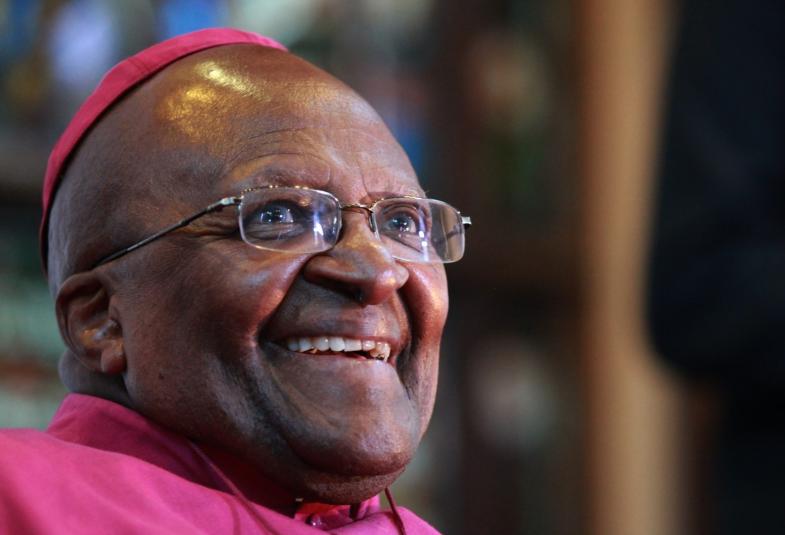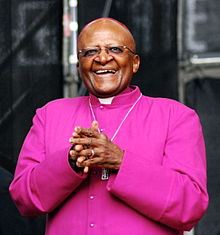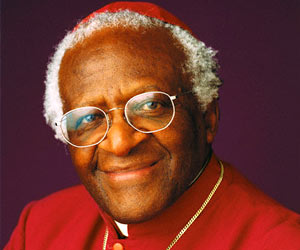
Desmond Mpilo Tutu is a South African Anglican cleric and theologian known for his work as an anti-apartheid and human rights activist. He was the Bishop of Johannesburg from 1985 to 1986 and then the Archbishop of Cape Town from 1986 to 1996, in both cases being the first indigenous black African to hold the position. Theologically, he sought to fuse ideas from black theology with African theology; politically, he identifies as a socialist.
Tutu was born of mixed Xhosa and Motswana heritage to a poor family in Klerksdorp, British Imperial South Africa. Entering adulthood, he trained as a teacher and married Nomalizo Leah Tutu, with whom he had several children. In 1960, he was ordained as an Anglican priest and in 1962 moved to the United Kingdom to study theology at King's College London. In 1966 he returned to southern Africa, teaching at the Federal Theological Seminary and then the University of Botswana, Lesotho and Swaziland. In 1972, he became the Theological Education Fund's director for Africa, a position based in London but necessitating regular tours of the African continent. Back in southern Africa in 1975, he served first as dean of St Mary's Cathedral in Johannesburg and then as Bishop of Lesotho, taking an active role in opposition to South Africa's apartheid system of racial segregation and white-minority rule. From 1978 to 1985 he was general-secretary of the South African Council of Churches, emerging as one of South Africa's most prominent anti-apartheid activists. Although warning the National Party government that apartheid would lead to racial violence, as an activist he stressed non-violent protest and foreign economic pressure to bring about change.
In 1985 he became Bishop of Johannesburg and in 1986 the Archbishop of Cape Town, the most senior position in southern Africa's Anglican hierarchy. In this position he emphasised a consensus-building model of leadership and oversaw the introduction of women priests. Also in 1986, he became president of the All Africa Conference of Churches, resulting in further tours of the continent. After President F. W. de Klerk released the anti-apartheid activist Nelson Mandela from prison in 1990 and the pair led negotiations to dissolve apartheid, Tutu assisted as a mediator between rival black factions. After the 1994 general election resulted in a coalition government headed by Mandela, the latter selected Tutu to chair the Truth and Reconciliation Commission to investigate past human rights abuses committed by both pro and anti-apartheid groups. Since apartheid's fall, Tutu has campaigned for gay rights and spoken out on a wide range of subjects, among them the Israel-Palestine conflict, his opposition to the Iraq War, and his criticism of South African Presidents Thabo Mbeki and Jacob Zuma. In 2010, he retired from public life.
Tutu polarised opinion as he rose to notability in the 1970s. White conservatives who supported apartheid despised him, while many white liberals regarded him as too radical; many black radicals accused him of being too moderate and focused on cultivating white goodwill, while Marxist-Leninists criticised his anti-communist stance. He was widely popular among the black majority, and was internationally praised for his anti-apartheid activism, receiving a range of awards, including the Nobel Peace Prize. He has also compiled several books of his speeches and sermons.
Desmond Mpilo Tutu was born on 7 October 1931 in Klerksdorp, a city in northwest South Africa. His mother, Allen Dorothea Mavoertsek Mathlare, was born to a Motswana family in Boksburg. His father, Zachariah Zelilo Tutu, was from the amaFengu branch of Xhosa and had grown up in Gcuwa, Eastern Cape. At home, the couple both spoke the Xhosa language. Zachariah trained as a primary school teacher at Lovedale college before taking a post in Boksburg, where he married his wife. In the late 1920s, he took a job in Klerksdorp; in the Afrikaaner-founded city, he and his wife resided in the black residential area. Established in 1907, it was then known as the "native location" although was later renamed Makoetend. The native location housed a diverse community; although most residents were Tswana, it also housed Xhosa, Sotho, and a few Indian traders. Zachariah worked as the principal of a Methodist primary school and the family lived in the schoolmaster's house, a small mud-brick building in the yard of the Methodist mission.
Church of Christ the King The Church of Christ the King in Sophiatown, where Tutu was a server under priest Trevor Huddlestone The Tutus were poor; describing his family, Tutu later related that "although we weren't affluent, we were not destitute either". Tutu had an older sister, Sylvia Funeka, who called him "Mpilo" ("life"), a name given to him by his paternal grandmother. The rest of the family called him "Boy". He was his parent's second son; their firstborn boy, Sipho, had died in infancy. Another daughter, Gloria Lindiwe, would be born after him. Tutu was sickly from birth; polio resulted in the atrophy of his right hand, and on one occasion he was hospitalised with serious burns. Tutu had a close relationship with his father, although was angered at the latter's heavy drinking, during which he would sometimes beat his wife. The family were initially Methodists and Tutu was baptised into the Methodist Church in June 1932. They subsequently changed denominations, first to the African Methodist Episcopal Church and then to the Anglican Church.
In 1936, the family moved to Tshing, where Zachariah was employed as the principle of a Methodist school; they lived in a hut in the school yard. There, Tutu started his primary education and played football with the other children, also becoming the server at St Francis Anglican Church. He developed a love of reading, particularly enjoying comic books and European fairy tales. Here, he also learned Afrikaans, the main language of the area. It was in Tshing that his parents had a third son, Tamsanqa, who also died in infancy. Around 1941, Tutu's mother moved to Witwatersrand to work as a cook at Ezenzeleni, an institute for the blind in western Johannesburg. Tutu joined her in the city, first living with an aunt in Roodepoort West before they secured their own house in the township. In Johannesburg, he attended a Methodist primary school before transferring to the Swedish Boarding School in the St Agnes Mission. Several months later, he moved with his father to Ermelo, eastern Transvaal. After six months, the duo returned to live with the rest of the family in Roodepoort West, where Tutu resuming his studies at SBS. He had pursued his interest in Christianity and at the age of 12 underwent confirmation at St Mary's Church, Roodepoort.
Tutu failed the arithmetic component of his primary school exam, but despite this, his father secured him entry to the Johannesburg Bantu High School in 1945, where he excelled academically. There, he joined a school rugby team, developing a lifelong love of the sport. Outside of school, he earned money selling oranges and as a caddie for white golfers. To avoid the expense of a daily train commute to school, he briefly lived with family nearer to Johannesburg, before moving back in with his parents when they relocated to Munsieville. He then returned to Johannesburg by moving into a hostel that was part of the Anglican complex surrounding the Church of Christ the King in Sophiatown. He became a server at the church and came under the influence of its priest, Trevor Huddleston; later biographer Shirley du Boulay suggested that Huddleston was "the greatest single influence" in Tutu's life. In 1947, Tutu contracted tuberculosis and was hospitalised in Rietfontein for 18 months, during which he spent much of his time reading and was regularly visited by Huddleston.[34] In the hospital, he underwent a circumcision to mark his transition to manhood. He returned to school in 1949 and took his national exams in late 1950, gaining a second-class pass.