The Hausa (autonyms for singular: Bahaushe (m), Bahaushiya (f); plural: Hausawa and general: Hausa; exonyms: Ausa; Francophonic spelling: Haoussa) are one of the largest ethnic groups in Africa. The Hausa are a diverse but culturally homogeneous people based primarily in the Sahelian and Sudanian Daura area of northern Nigeria and southeastern Niger, with significant numbers living in Cameroon, Ivory Coast, Chad, Togo, Ghana, Sudan, Gabon and Senegal.
Predominantly Hausa-speaking communities are scattered throughout West Africa and on the traditional Hajj route north and east traversing the Sahara, with an especially large population in and around the town of Agadez. Other Hausa have also moved to large coastal cities in the region such as Lagos, Accra, Abidjan, Banjul and Cotonou as well as to parts of North Africa such as Libya over the course of the last 5,000 years. Most Hausa, however, live in small villages or towns in Africa, where they grow crops, raise livestock including cattle and engage in trade. They speak the Hausa language, an Afro-Asiatic language of the Chadic group. The Hausa aristocracy had historically developed an equestrian based culture. Still a status symbol of the traditional nobility in Hausa society, the horse still features in the Eid day celebrations, known as Ranar Sallah (in English: the Day of the Prayer). Daura city is the cultural centre of the Hausa people. The town predates all the other major Hausa towns in tradition and culture.
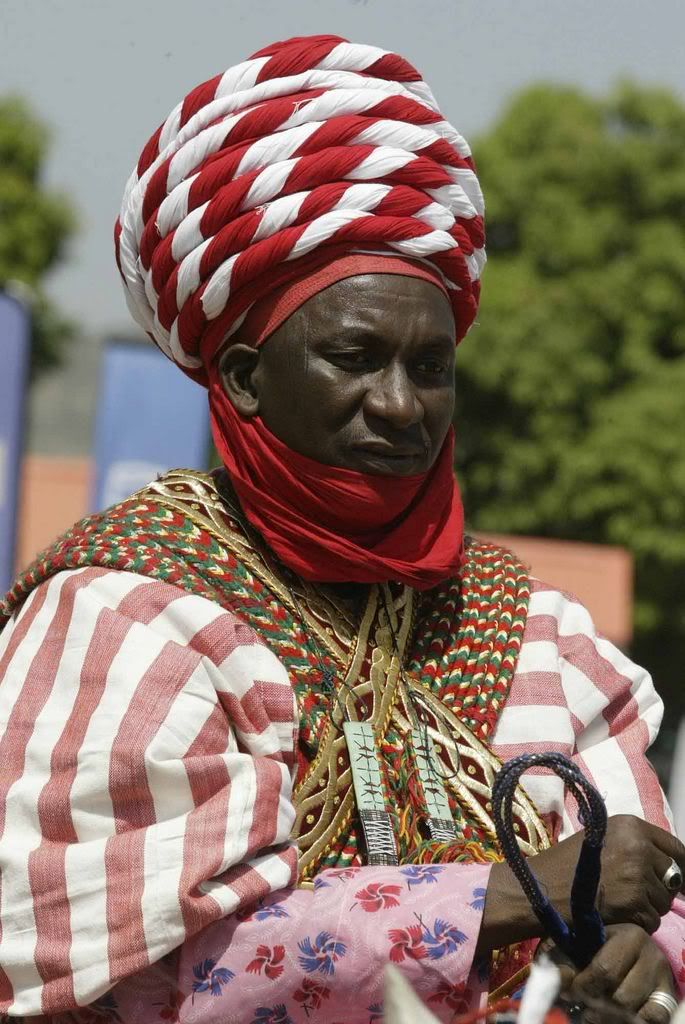
The Emir of Muri, Alhaji Abbas Tafida, and his vizier A table of Hausa ethnic population by country:
Traditional Hausa attire
Gate to the Gidan Rumfa
The Hausa–Fulani Sokoto Caliphate in the 19th century Daura, in northern Nigeria, is the oldest city of Hausaland. The Hausa of Sokoto, also in northern Nigeria, speak the oldest surviving classical vernacular of the language. Historically Sokoto was the centre of Hausa Islamic scholarship.
The Hausa are culturally and historically closest to other Sahelian ethnic groups, primarily the Fula; the Zarma and Songhai (in Tillabery, Tahoua and Dosso in Niger); the Kanuri and Shuwa Arabs (in Chad, Sudan and northeastern Nigeria); the Tuareg (in Agadez, Maradi and Zinder); the Gur and Gonja (in northeastern Ghana, Burkina Faso, northern Togo and upper Benin); Gwari (in central Nigeria); and the Mandinka, Bambara, Dioula and Soninke (in Mali, Senegal, Gambia, Ivory Coast and Guinea). Migrants from these areas introduced various Africanised Islamic teachings to many Hausa by the 14th century, although Islam itself had a presence in Hausaland as early as the 11th century among the ruling class.
All of these various ethnic groups among and around the Hausa live in the vast and open lands of the Sahel, Saharan and Sudanian regions, and as a result of the geography and the cross crossing network of traditional African trade routes, have influenced each other's cultures to varying degrees. Today some Fula people cannot be distinguished from Hausa people in many northern states of Nigeria, due to inter-marriage and cultural assimilation. In Agadez and Saharan areas of central Niger, the Tuareg and Hausa groups are indistinguishable from each other in their traditional clothing; both wear the tagelmust and indigo Babban Riga/Gandora. But the two groups differ in language, lifestyle and preferred beasts of burden (the Tuareg use camels, while Hausa ride horses).
Other Hausa have mixed with ethnic groups such as the Yoruba and Shuwa, incorporating the foods and style of dress into local Hausa customs, as well as heavily influencing the cultures of these groups. Islamic Shari’a law is loosely the law of the land in Hausa areas, well understood by any Islamic scholar or teacher, known in Hausa as a m'allam, mallan or malam (see Maulana). This pluralist attitude toward ethnic-identity and cultural affiliation has enabled the Hausa to inhabit one of the largest geographic regions of non-Bantu ethnic groups in Africa.
The Nok culture appeared in Northern Nigeria around 1000 BC and vanished under unknown circumstances around 300 AD in the region of West Africa. It is believed to be the product of an ancestral nation that branched to create the Hausa, Gwari, Birom, Kanuri, Nupe and Jukun peoples. The Kwatarkwashi Culture or Sokoto Culture located to the North west of Nok is thought to be the same as or an earlier ancestor of the Nok.
Nok's social system is thought to have been highly advanced. The Nok culture is considered to be the earliest sub-Saharan producer of life-sized Terracotta.
The refinement of this culture is attested to by the image of a Nok dignitary at the Minneapolis Institute of Arts. The dignitary is portrayed wearing a "crooked baton". The dignitary is also portrayed sitting with flared nostrils, and an open mouth suggesting performance. Other images show figures on horseback, indicating that the Nok culture possessed the horse.
Iron use, in smelting and forging for tools, appears in Nok culture in Africa at least by 550 BC and possibly earlier. Christopher Ehret has suggested that iron smelting was independently discovered in the region prior to 1000 BC.
In the 7th century, the Dala Hill in Kano was the site of a Hausa community that migrated from Gaya and engaged in iron-working. The Hausa began to adopt Islam as early as the 11th century CE although in small numbers. The vast majority still practised Hausa Animism at this time. The Hausa Bakwai kingdoms were established around the 7th to 11th centuries. Of these, the Kingdom of Daura was the first, according to the Bayajidda Legend.
The Hausa Kingdoms were independent political entities in what is now Northern Nigeria. The Hausa city states emerged as southern terminals of the Trans-Saharan caravan trade. Like other cities such as Gao and Timbuktu in the Mali Empire, these city states became centres of long distance trade. Hausa merchants in each of these cities collected trade items from domestic areas and from the rain forest region to the south through trade or raiding, processed (and taxed) them and then sent them north to cities along the Mediterranean. The trade influenced political development as ideas (and people) from the Middle East and North Africa made their way south to the cities. In fact the Hausa city state creation myth suggests that northern influence. According to the Bayajidda Legend, the city states began when Bayajidda, a prince of Baghdad, arrived in Daura (the oldest of the Hausa city states) and married the queen of the town. Their seven sons founded the other states of Katsina, Zazzau, Gobir, Kano, Rano, and Biram. These 7 cities are known as the Hausa Bakwai which means Hausa 7.
By the 12th century AD the Hausa were becoming one of Africa's major trading powers, competing with Kanem-Bornu and the Mali Empire. The primary exports were leather, gold, cloth, salt, kola nuts, slaves, animal hides, and henna. Certainly trade influenced religion. By the 14th century, Islam was becoming widespread in Hausaland as Wangara scholars, scholars and traders from Mali and scholars and traders from the Maghreb brought the religion with them.
The architecture of the Hausa is perhaps one of the least known but most beautiful of the medieval age. Many of their early mosques and palaces are bright and colourful, including intricate engraving or elaborate symbols designed into the facade. This architectural style is known as Tubali which means architecture in the Hausa language.
The ancient Kano city walls were built in order to provide security to the growing population. The foundation for the construction of the wall was laid by Sarki Gijimasu from 1095 - 1134 and was completed in the middle of the 14th century. In the 16th century, the walls were further extended to their present position. The gates are as old as the walls and were used to control movement of people in and out of the city.
By the early 15th century the Hausa were using a modified Arabic script known as ajami to record their own language; the Hausa compiled several written histories, the most popular being the Kano Chronicle. Many medieval Hausa manuscripts similar to the Timbuktu Manuscripts written in the Ajami script, have been discovered recently some of them even describe constellations and calendars.
The Gobarau Minaret was built in the 15th century in Katsina. It is a 50-foot edifice located in the centre of the city of Katsina, the capital of Katsina State. The Gobarau minaret, a symbol of the state, is an early example of Islamic architecture in a city that prides itself as an important Islamic learning centre. The minaret is believed to be one of West Africa's first multi-storey buildings and was once the tallest building in Katsina. The mosque's origin is attributed to the efforts of the influential Islamic scholar Sheikh Muhammad al-Maghili and Sultan Muhammadu Korau of Katsina. Al-Maghili was from the town of Tlemcen in present-day Algeria and taught for a while in Katsina, which had become a centre of learning at this time, when he visited the town in the late 15th century during the reign of Muhammadu Korau. He and Korau discussed the idea of building a mosque to serve as a centre for spiritual and intellectual activities. The Gobarau mosque was designed and built to reflect the Timbuktu-style of architecture. It became an important centre for learning, attracting scholars and students from far and wide, and later served as a kind of university.
Muhammad Rumfa was the Sultan of the Sultanate of Kano, located in modern-day Kano State, Northern Nigeria. He reigned from 1463 until 1499. Among Rumfa's accomplishments were extending the city walls, building a large palace, the Gidan Rumfa, promoting slaves to governmental positions and establishing the great Kurmi Market, which is still in use today. Kurmi Market is among the oldest and largest local markets in Africa. It used to serve as an international market where North African goods were exchanged for domestic goods through trans-Saharan trade. Muhammad Rumfa was also responsible for much of the Islamisation of Kano, as he urged prominent residents to convert.
Durbar festival in Nigeria The legendary Queen Amina (or Aminatu) is believed to have ruled Zazzau between the 15th century and the 16th century for a period of 34 years. Amina was 16 years old when her mother, Bakwa Turunku became queen and she was given the traditional title of Magajiya, an honorific borne by the daughters of monarchs. She honed her military skills and became famous for her bravery and military exploits, as she is celebrated in song as "Amina, daughter of Nikatau, a woman as capable as a man." Amina is credited as the architectural overseer who created the strong earthen walls that surround her city, which were the prototype for the fortifications used in all Hausa states. She subsequently built many of these fortifications, which became known as ganuwar Amina or Amina's walls, around various conquered cities. The objectives of her conquests were twofold: extension of her nation beyond its primary borders and reducing the conquered cities to a vassal status. Sultan Muhammad Bello of Sokoto stated that, "She made war upon these countries and overcame them entirely so that the people of Katsina paid tribute to her and the men of Kano and... also made war on cities of Bauchi till her kingdom reached to the sea in the south and the west." Likewise, she led her armies as far as Kwararafa and Nupe and, according to the Kano Chronicle, "The Sarkin Nupe sent her (i.e. the princess) 40 eunuchs and 10,000 kola nuts."
From 1804-1808, the Fulani, another Islamic African ethnic group that spanned West Africa and shared the area with the Hausa, invaded the Hausa states, starting with Gobir under the leadership of Sheikh Usman Dan Fodio. He declared Jihad on the traditional Habe dynasty kings for their alleged greed, paganism, injustices against the peasant class, use of heavy taxation and violation of the standards of Sharia law. The Fulani and Hausa cultural similarities as a Sahelian people however allowed for significant integration between the two groups. When the Fulani took over the Hausa city-state of Kano during the expansion of the Sokoto Caliphate, the new emirs ended up speaking the Hausa language instead of Fulfulde over the years. Since the early 20th century, these peoples are often classified as "Hausa-Fulani" within Nigeria rather than as individuated groups. In fact a large number of Fulani living in Hausa regions cannot speak Fulfulde at all and speak Hausa as their first language. Many Fulani in the region do not distinguish themselves from the Hausa, as they have long intermarried, they share the Islamic religion and many integrated into Hausa culture.
British General Frederick Lugard used rivalries between many of the emirs in the south and the central Sokoto administration to prevent any defence as he worked toward the capital. As the British approached the city of Sokoto, the new Sultan Muhammadu Attahiru I organised a quick defence of the city and fought the advancing British-led forces. The British forces won, sending Attahiru I and thousands of followers on a Mahdist hijra.
The Hausa eternal knot, a traditional symbolic indicator of Hausa identity On 13 March 1903 at the grand market square of Sokoto, the last Vizier of the Caliphate officially conceded to British Rule. The British appointed Muhammadu Attahiru II as the new Caliph. Lugard abolished the Caliphate, but retained the title Sultan as a symbolic position in the newly organised Northern Nigeria Protectorate. In June 1903, the British defeated the remaining forces of Attahiru I and killed him; by 1906 resistance to British rule had ended. The area of the Sokoto Caliphate was divided among the control of the British, French, and Germans under the terms of their Berlin Conference.
The British established the Northern Nigeria Protectorate to govern the region, which included most of the Sokoto empire and its most important emirates. Under Lugard, the various emirs were provided significant local autonomy, thus retaining much of the political organisation of the Sokoto Caliphate. The Sokoto area was treated as just another emirate within the Nigerian Protectorate. Because it was never connected with the railway network, it became economically and politically marginal.
But, the Sultan of Sokoto continued to be regarded as an important Muslim spiritual and religious position; the lineage connection to dan Fodio has continued to be recognised. One of the most significant Sultans was Siddiq Abubakar III, who held the position for 50 years from 1938-1988. He was known as a stabilising force in Nigerian politics, particularly in 1966 after the assassination of Ahmadu Bello, the Premier of Northern Nigeria.
Following the construction of the Nigerian railway system, which extended from Lagos in 1896 to Ibadan in 1900 and Kano in 1911, the Hausa of northern Nigeria became major producers of groundnuts. They surprised the British, who had expected the Hausa to turn to cotton production. However, the Hausa had sufficient agricultural expertise to realise cotton required more labour and the European prices offered for groundnuts were more attractive than those for cotton. "Within two years the peasant farmers of Hausaland were producing so many tonnes of groundnuts that the railway was unable to cope with the traffic. As a result, the European merchants in Kano had to stockpile sacks of groundnuts in the streets.".
The Boko script was imposed on the Hausa by the British and French colonial forces and made the official Hausa alphabet in 1930. Boko is a Latin alphabet used to write the Hausa language. The first boko was devised by Europeans in the early 19th century, and developed in the early 20th century by the British (mostly) and French colonial authorities. Since the 1950s boko has been the main alphabet for Hausa. Arabic script (ajami) is now only used in Islamic schools and for Islamic literature. Today millions of Hausa-speaking people, who can read and write in Ajami only, are considered illiterates by the Nigerian government. Despite this, Hausa Ajami is present on Naira banknotes. In 2014, in a very controversial move, Ajami was removed from the new 100 Naira banknote.
Nevertheless, the Hausa remain preeminent in Niger and Northern Nigeria.