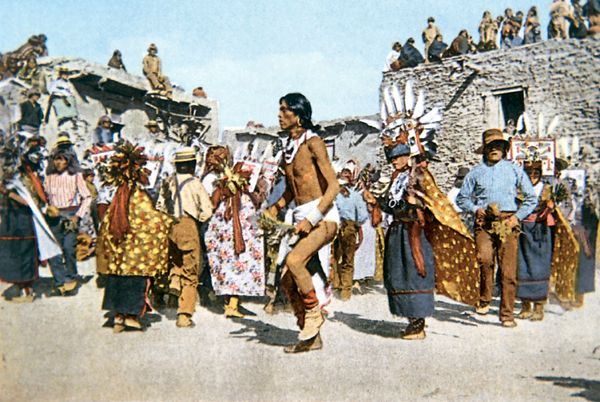
These kachina dances, which Graham and several other major choreographers saw in America's Southwestern region, are the public part of an elaborate religious lifestyle. The kaehinas of the American Southwest exist in over 250 ieonographic forms which are best known to non-Indians in the form of dolls — small painted and decorated figures carved from wood. These dolls are given to Pueblo children so they can learn to identify the various kaehinas. The dolls are learning tools, not sacred objects.
Once the members of the tribal societies who "impersonate' the kaehinas in ceremonial events don their costumes and masks and take up theii paraphernalia, they become sacred reflections of the powers of the kaehinas; the) may not be touched or involved in human conversation or any other form o exchange. The fact that kaehinas are sacred doesn't obstruct their potential fo actions that are grotesque, outrageous, and highly humorous — all such qualitie exist in the great sacred rites of many primal people.