A Long History of Painting Beyond the Canvas
Sometimes a canvas, gallery, or studio isn't enough to hold an artist's creativity — the work moves outdoors instead. Street painting traces back to at least the early 16th century in Italy, and pavement art took hold in Britain starting in the 1890s. Since then, cities around the world — including Atlanta, Georgia — have built their own street painting traditions. It remains a significant artistic investment in beautifying public space, even where city planners haven't always welcomed it. The techniques behind that work vary widely, each suited to a different surface, timeline, and effect.
Spray Paint
Spray paint is one of the most common street painting techniques, prized for how quickly it covers large areas compared to a brush and canvas. It works across a wide range of surfaces — walls, carts, trees, windows — which is part of why it became the default medium for large-scale outdoor graffiti and mural work.
Stencil
Stencil work trades speed for precision: a cut template lets an artist get the image right on the first pass, which matters when working quickly or in a location where lingering too long isn't an option. Combined with liquid paints, stencils give an artist strong color flexibility and the ability to produce large, clean images fast.
Tile and Mosaic
Mosaic work is the slowest technique on this list but produces some of the most durable, detailed results. Small pieces of glass, stone, or ceramic are arranged into an image — often assembled off-site — before being installed at its final public location.
Sand Art and Sculpture
Sand art shapes and molds sand directly into a sculptural piece on the street. It demands real time and physical effort, and the result is inherently temporary, but the immediacy of watching it take shape is part of its appeal.
LED and Light-Based Work
LED installations use light itself as the medium, creating graffiti-style images that read differently after dark than any paint-based technique could. The effect is often striking enough to draw a crowd on its own.
3D Street Art
3D street art uses forced perspective to create images on pavement or walls that appear to have real depth — a painted hole in the road, or a wall that seems to fall away into space. The illusion is part of the draw, turning a flat surface into something people want to photograph and interact with.
Paste-Ups and Wheatpaste
Paste-up techniques — including work created on paper and adhered to a wall using wheatpaste — let an artist build a detailed image in the studio, then bring it into public space without painting directly on-site. This gives more control over fine detail than working freehand on a wall allows.
Murals
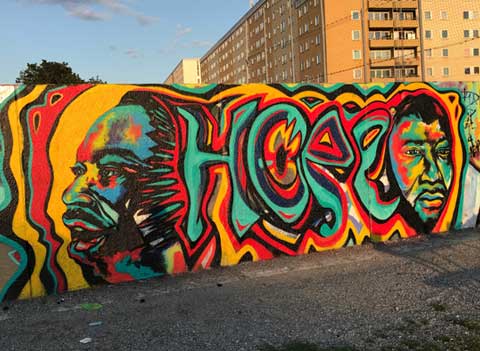
Murals remain the most enduring and visible form of street painting: large-scale work painted directly onto a wall, ceiling, or other large surface, built to transform the space for years rather than days.
Carrying the Tradition Forward
Street painting's techniques have evolved for centuries, and the tradition continues today through artists working in cities across the country — including Corey Barksdale in Atlanta, Georgia, who has taken part in mural arts competitions and produced large-scale decorative and public painting work since 2012.